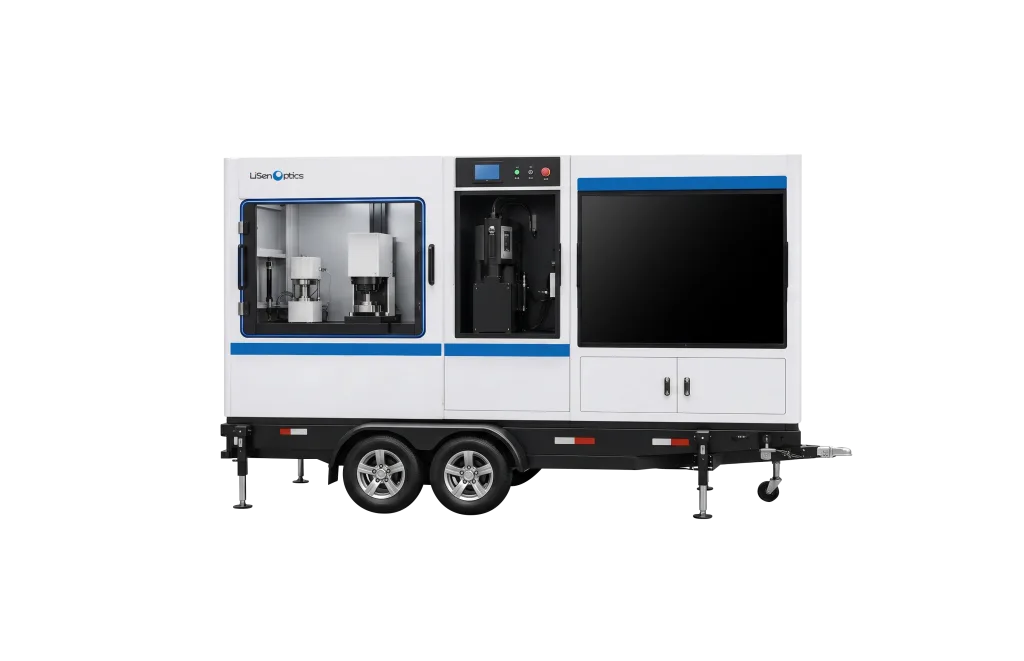
Automated Coal Ash and Elemental Analysis
The LiSen Optics iSpecLIBS-Coal uses laser-induced breakdown spectroscopy (LIBS) to measure coal ash content and key elements on site. It automates the workflow from wet-sample intake through drying, grinding, pelletizing, measurement, and reporting, removing the need for complex manual preparation and separate laboratory testing.
The system addresses matrix effects and spectral interference through quantitative models developed for different coal types and mining regions. Results support process adjustments, quality control, and commercial pricing at coal mines, preparation plants, trading operations, and power plants.
Technical Specifications
| Parameter | iSpecLIBS-Coal |
|---|---|
| Product Image |
 |
| Laser | Pulse energy: 100 mJ; wavelength: 1064 nm; pulse width: ≤10 ns |
| Spectrometer | Spectral range: 180-1050 nm (optional); resolution: ≤0.1 nm |
| Sample Types / Analytes | Thermal coal, coking coal, anthracite, clean coal, middlings, coal gangue, and related materials. Ash-related oxides include SiO₂, Al₂O₃, Fe₂O₃, CaO, MgO, K₂O, Na₂O, and TiO₂. Other key elements include C, S, and P. |
| Concentration Range | 10 ppm to percent levels, depending on the element and sample matrix; ppm-level detection is available for selected elements. |
| Total Analysis Time | ≤15 minutes from wet-sample receipt to result, including drying, preparation, measurement, and calculation. |
| Calculated Parameters | Ash content, calorific value, volatile matter, carbon content, and other coal-quality parameters. |
| Algorithm Suite | Includes dark-background subtraction, baseline correction, intensity normalization, and dedicated PLS/SVM/ANN models for quantitative ash and elemental analysis. |
| XYZ Stage | Travel: X 50 mm, Y 50 mm, Z 50 mm; Positioning accuracy: ±0.01 mm; repeatability: ±0.005 mm; Maximum speed: 20 mm/s; continuous scanning supported |
| Data Formats | CSV, XLSX |
| Report Generation | Supported |
| Analysis Modes | Semi-quantitative and quantitative |
| Accuracy | ≤0.5% |
| Argon Purge | Argon purge is used as required for specific target elements; removable optical window for easy cleaning. |
| Operating Temperature | 0-40 °C |
| Ingress Protection | IP54 |
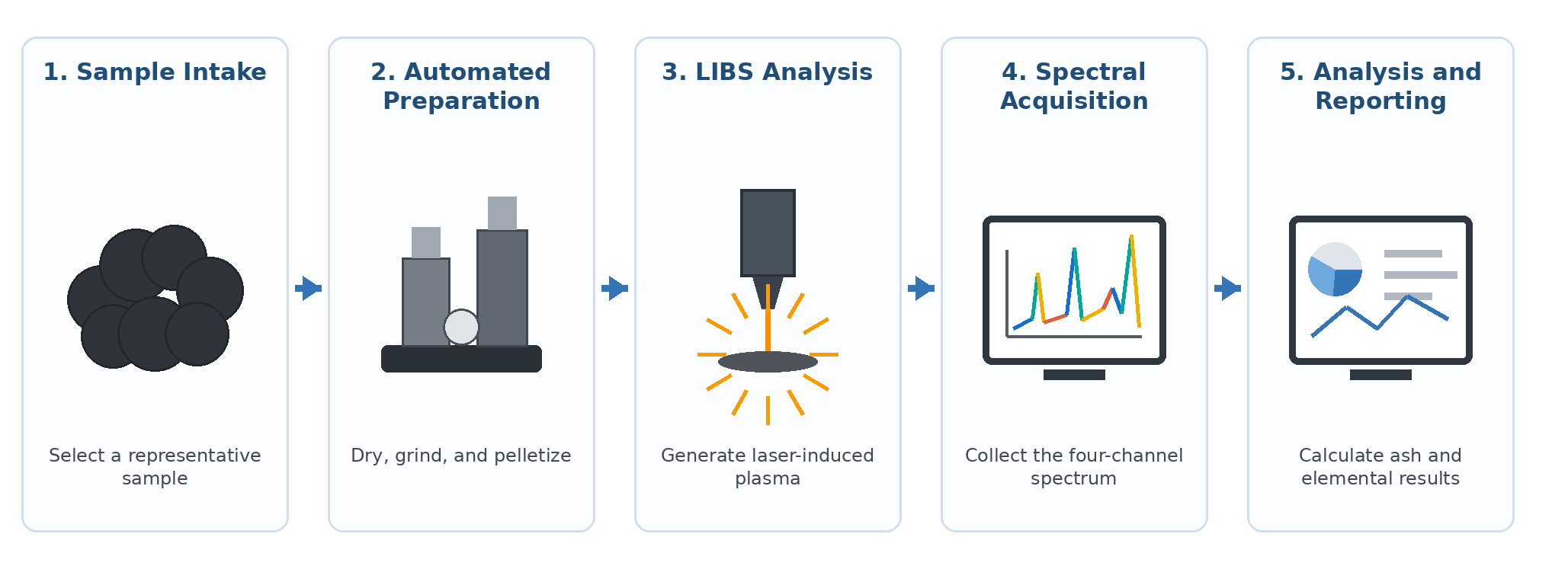
From Wet Sample to Results in 15 Minutes or Less
After a representative sample is loaded, the system automatically dries, grinds, and pelletizes it. Laser excitation generates a plasma, and the four-channel spectrometer collects the emission spectrum. The software then calculates ash and elemental results and generates a report. The complete sequence, from receipt of a wet sample to the calculated result, takes ≤15 minutes.
Coal Analysis Software
A single control environment coordinates the instrument modules and analysis workflow. Built-in tools support ash prediction, calibration modeling, and trend analysis.
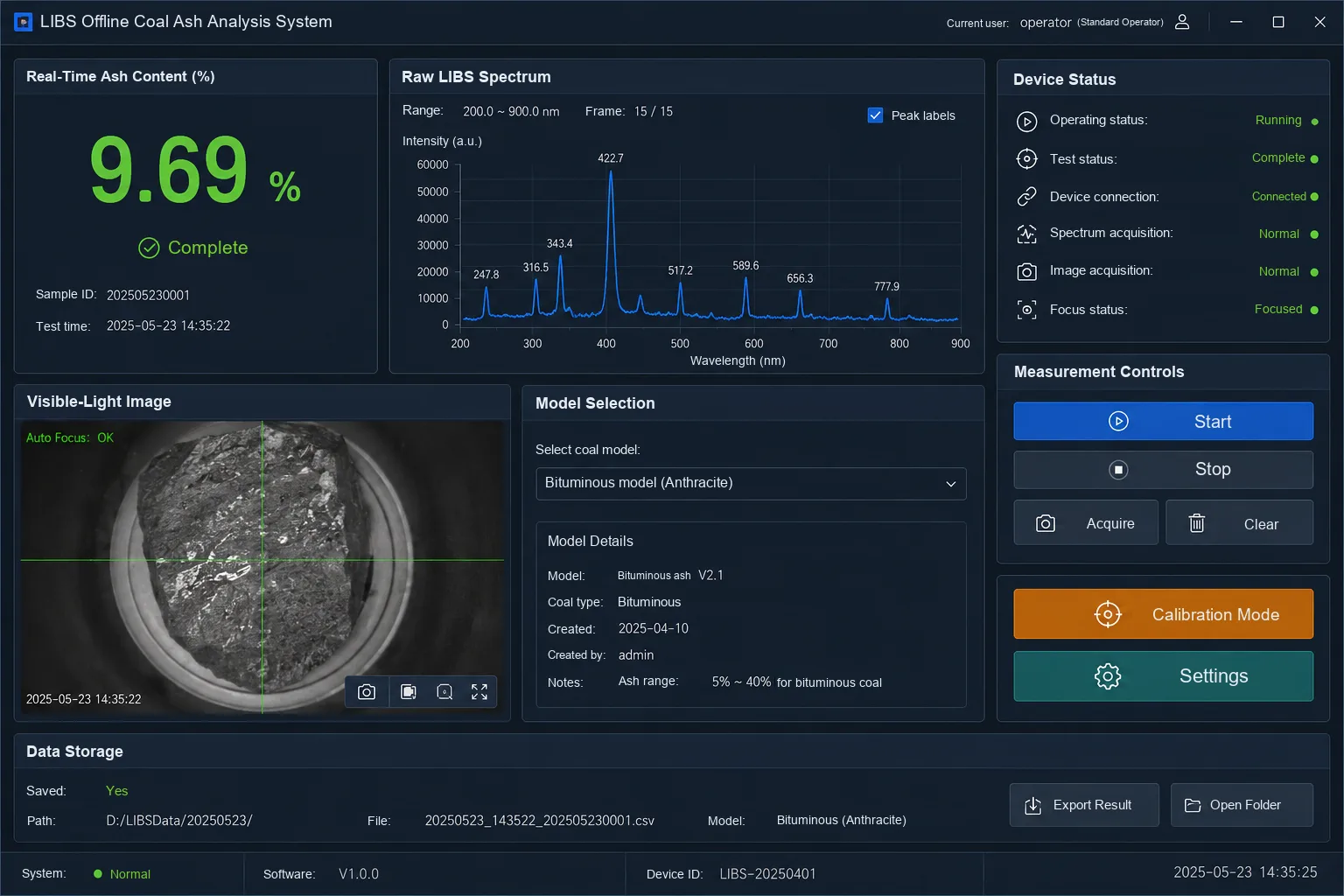
Analysis Interface
The analysis screen brings together ash content, the LIBS spectrum, the visible-light sample image, model selection, device status, and measurement controls.
Control and Analysis Functions
- Integrated Device Control
- Coordinates the spectrometers, pulse-delay generator, XYZ stage, laser, and other core modules through a unified control environment.
- Centralized Parameter Control
- Provides unified configuration of spatial, timing, and excitation parameters for synchronized multi-device operation.
- Operating Condition-Spectrum Correlation
- Maps scan conditions directly to LIBS spectra and tracks spectral changes under different operating conditions.
- Fully Automated Mapping
- Supports user-defined scan areas and stepwise scans with configurable integration time, gate delay, and laser energy.
- Spectral Acquisition and Preprocessing
- Acquires spectra and applies background subtraction, baseline correction, and other preprocessing routines to improve data consistency.
- Automatic Peak and Element Identification
- Uses the integrated NIST database for automatic peak finding and real-time matching of elemental emission lines.
- Multielement Quantitative Analysis
- Combines multielement models with spectral deconvolution to quantify multiple elements in complex samples.
- Custom Modeling and Calibration
- Supports elemental calibration, linear and polynomial fitting, peak ratios, peak-area calculations, and user-defined model optimization.
- Results and Validation
- Outputs elemental concentrations, uncertainty estimates, and statistical significance metrics for result validation.
- Advanced Algorithm Integration
- Provides interfaces for machine-learning and deep-learning algorithms to improve complex-sample identification and intelligent analysis.
Data Management and Reporting
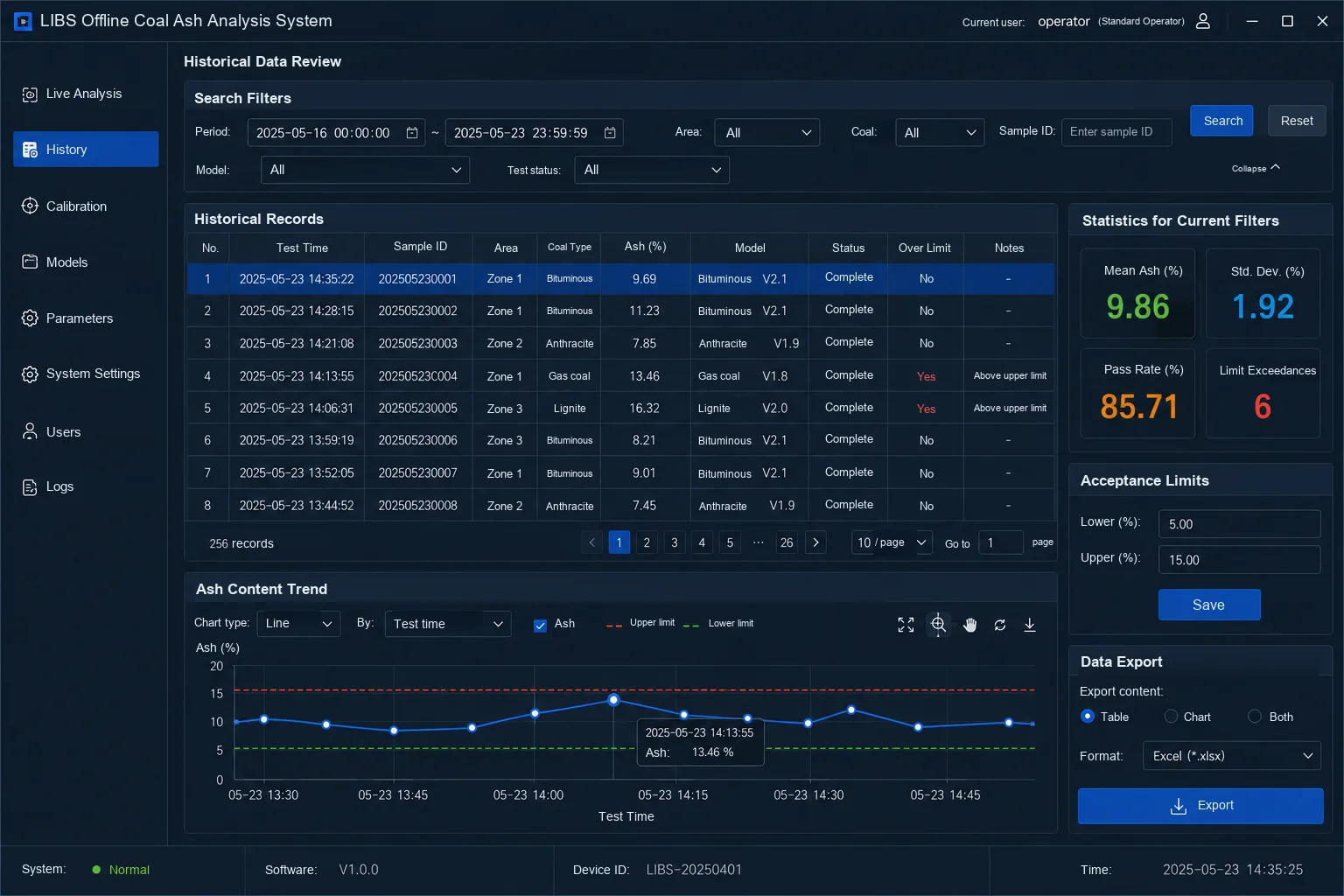
Historical records can be filtered by time, coal type, model, and test status. The software generates ash-trend charts and calculates the mean, standard deviation, and pass rate. Upper and lower limit alarms and classification across multiple models support ongoing quality monitoring.
Multiple export formats, audit logs, and user-permission controls support long-term operation and centralized data management at coal preparation plants, mine sites, and ports.
Mobile Deployment for Coal Quality Control
The trailer-mounted system can be deployed at coal preparation plants, mines, ports, and other field locations. Its integrated industrial design provides vibration and dust resistance for demanding operating environments.
Supported materials include thermal coal, coking coal, anthracite, clean coal, middlings, coal gangue, and related materials. In addition to ash-related oxides and key elements, the software calculates coal-quality parameters such as calorific value, volatile matter, and carbon content.
Explore the LIBS elemental analyzer range or contact LiSen Optics to discuss coal types, calibration models, and on-site deployment.